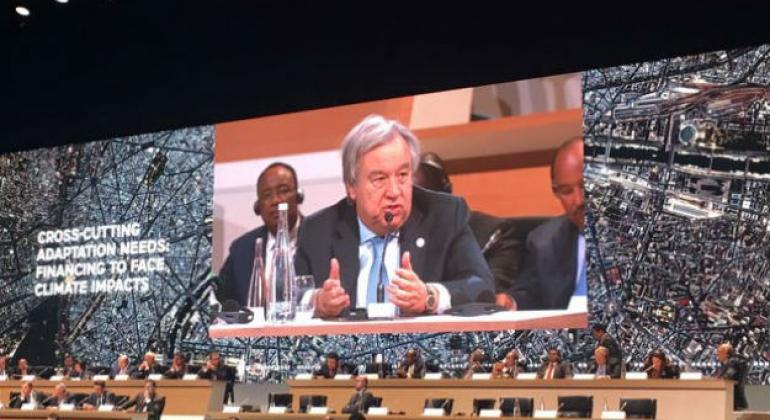
UN Secretary General: “Fossil fuels must forever remain where they belong: underground.” to be underground,” Guterres said. The Secretary General acknowledged that many countries, companies, and financial institutions are taking encouraging steps. For example, the European Investment Bank has announced that it will stop financing fossil fuel projects by the end of 2021. But, according to Guterres, change is happening too slowly – at a time when a fundamental overhaul is needed. And first of all, the G20 countries, which account for three-quarters of global greenhouse gas emissions, must adapt. In addition to the extractive industries, agriculture, transportation, ineffective urban planning, construction, cement and steel production, as well as many other industries, contribute to climate change. We must completely change our way of life, argues the Secretary-General, citing the findings of international experts: “The way we do business, we produce energy, we build cities, how we move, how we produce food – all this needs to change dramatically and quickly.” Guterres noted that if governments had listened to scientists a decade ago and taken the necessary actions, they would have had to cut greenhouse gas emissions by 3.3 percent annually. But this did not happen. Today, in order to achieve our goals, we need to reduce emissions by 7.6 percent. But so far they are only growing: over the past 10 years, the volume of emissions has increased by 1.5 percent. The Secretary-General has repeatedly listed necessary steps, including eliminating fossil fuel subsidies, closing coal-fired power plants and transitioning to a green economy. He also called on participants at the Madrid conference to agree on measures on one of the most important issues: pricing and taxes on emissions, which states were unable to agree on at last year's meeting in Katowice. “We must finally prove that we are serious about stopping this war on nature.” “I call on all parties [to the UN Climate Change Convention] to overcome differences and reach mutual understanding on this issue,” said Guterres, who admitted he had high hopes for the current meeting: “We must complete our work without wasting time.” But beyond the successful conclusion of the negotiations, it is equally important, Guterres noted, to send a signal to the world that states are ready to change their course: “We must finally prove that we are serious about stopping this war on nature, that we have the political will necessary to reduce greenhouse gas emissions to zero by 2050.”
UN Secretary General: “Fossil fuels must forever remain where they belong: underground.”