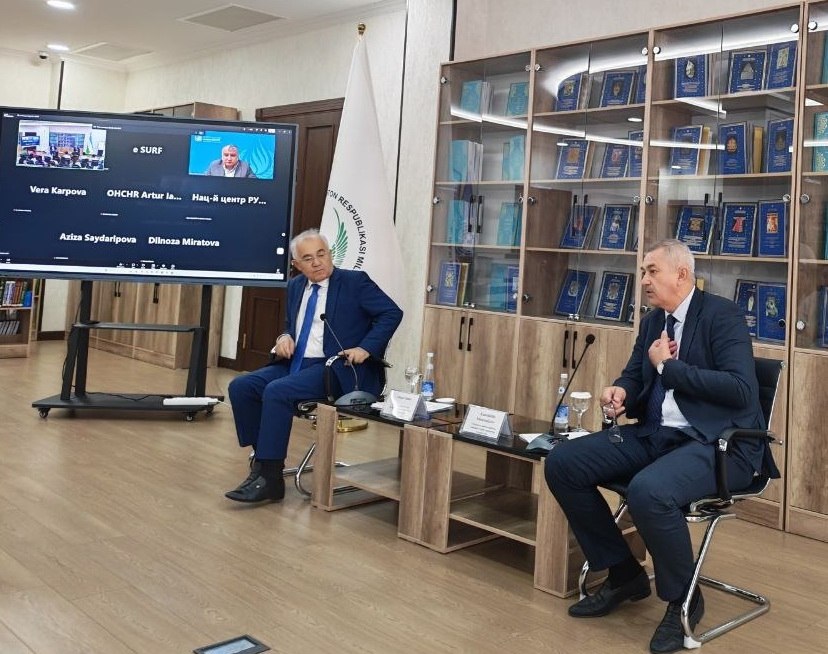
On August 28, members of the Public Council under the National Committee on Ecology and Climate Change of the Republic of Uzbekistan participated in a working meeting held at the National Human Rights Center of the Republic of Uzbekistan.
The meeting focused on the possibilities and procedures for preparing “alternative” reports on international human rights treaties, as well as Uzbekistan’s compliance with its obligations under international conventions. One of the key topics of discussion was Uzbekistan’s fulfillment of its obligations under the Aarhus Convention.
During the meeting, participants were briefed on the ongoing work to establish the Aarhus Center, as well as on ongoing activities to raise public awareness and ensure citizens’ access to environmental information.
Natalya Sergeevna Shivaldova, Chair of the Public Council under the National Committee on Ecology and Climate Change of the Republic of Uzbekistan, emphasized that work to establish the Orhurs Center and ensure access to environmentally relevant information is being carried out in close collaboration with staff of the State Environmental Expertise Center and with the expert support of the National Committee on Ecology and Climate Change of the Republic of Uzbekistan.
An important area of discussion was expanding civil society participation in issues related to the implementation of environmental rights and international obligations. Akmal Khalmatovich Saidov, Director of the Human Rights Center, proposed holding a series of regional seminars with broad participation of NGOs and civil society representatives. This initiative was supported by Kamolidin Nuritdinovich Ishankhodjaev, Chairman of the National Association of NGOs of Uzbekistan. Representatives of the Office of the UN High Commissioner for Human Rights also participated in the discussion, joining in online. The participation of Public Council members in such working meetings is important for developing an open dialogue between government agencies, civil society, and international partners, and for developing practical approaches to realizing citizens’ environmental rights. This contributes to the further development of constructive interaction between the state and civil society in the field of environmental protection.