Today in Uzbekistan, issues of water and industrial safety concern not only specialists — they directly affect people’s daily lives. Climate change is making summers hotter and drier, rivers are becoming shallower, and pressure on both groundwater and surface water resources is increasing. At the same time, access to safe drinking water remains uneven: reliable access is available to 75% of the rural population and 89% of urban residents.
The situation is further complicated by outdated wastewater treatment facilities: only about 32% of domestic wastewater undergoes safe treatment. However, these figures are not a cause for pessimism. They demonstrate the scale of the challenge that the country is already actively addressing by improving regulations, incorporating international experience, introducing new technologies, and strengthening systems to protect water resources and public health.
Yet water scarcity is only part of the problem. There is another serious threat — the safety of tailings storage facilities. These industrial sites, where waste from mining and metallurgical industries is accumulated, are often located near rivers and irrigation water sources. With growing climate risks, land subsidence, and increasing pressure on infrastructure, the risk of accidents and leakages is rising. For local populations, this means potential threats to health, drinking water safety, and the environmental condition of entire regions.
To strengthen protection against these risks, Uzbekistan is systematically building an early warning and integrated safety system. The project “Strengthening Activities in Uzbekistan in the Field of Water Supply, Sanitation and Protection of Water Resources from Accidental Pollution under Climate Change Conditions,” implemented by the UNECE with financial support from Switzerland, has become a key platform uniting the efforts of various agencies.
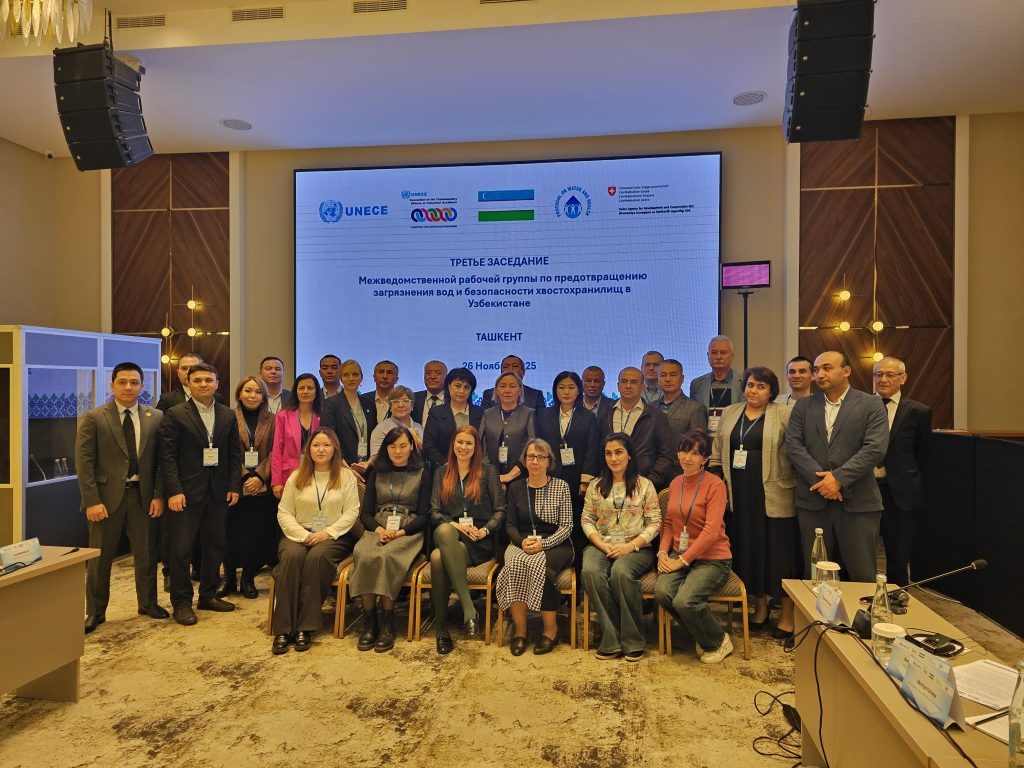
As part of the project, an Interagency Working Group was established to address issues related to water supply and sanitation, as well as the safety of industrial facilities and tailings storage sites. On November 26, another meeting of the group was held in Tashkent, demonstrating that the country is moving in the right direction.
During the meeting, the group approved the Work Plan for 2026, reflecting key cooperation priorities in these areas. The document includes the implementation of the Roadmap for Uzbekistan’s accession to the UNECE Convention on the Transboundary Effects of Industrial Accidents, as well as the completion of an analytical report on the impact of climate change on the safety of tailings storage facilities.
These steps not only strengthen the national risk management system but also create a foundation for closer international cooperation in industrial and environmental safety.
The meeting also presented opportunities for satellite monitoring of tailings storage facilities — a modern method that allows dangerous changes at these sites to be tracked. At the same time, issues related to water supply sustainability were discussed: where infrastructure modernization is needed, how wastewater treatment quality can be improved, which regions require priority support, and what measures are necessary to ensure systems can withstand climate fluctuations.
To achieve this, Uzbekistan is developing target indicators within the framework of the Protocol on Water and Health, which the country recently joined.
One of the major achievements was the approval in June 2025 of a new national wastewater treatment regulation, replacing rules that had been in place for nearly 40 years. The new approach is more practical for implementation and has already opened the way for investments and modernization of treatment facilities, directly affecting the quality of surface water and public health.
At the same time, Uzbekistan is actively progressing toward accession to the UNECE Convention on the Transboundary Effects of Industrial Accidents — a key legal instrument for improving the safety of industrial facilities, including tailings storage sites.
Work on establishing national intersectoral targets for water, sanitation, and health will continue in 2026 and will serve as the foundation for long-term improvements in water supply, sanitation, and resilience to climate risks.
This activity also fits into a broader context: in 2025, the Protocol on Water and Health marks the 20th anniversary of its entry into force, and Uzbekistan became the first Central Asian country to join it. This highlights the country’s commitment to shifting from reacting to risks toward preventing them.
The work being carried out today is not about formalities. It is about ensuring that people can rely on clean and stable water supplies, that hazardous industrial facilities are not located near their homes, that urban and rural schools receive safe water, and that natural water sources are reliably protected.
Step by step, a system is being built in which water and industrial safety are considered together — as two interconnected elements of the country’s health, sustainability, and future.